
Async standups have become the standard for modern engineering teams. But not all standup tools are created equal.
If you've searched for "best async standup tool" or "Geekbot alternatives," you've likely encountered a crowded market: Geekbot, Standuply, Steady, Range, and dozens of others all promising to replace your daily sync meetings.
The problem? Most of these tools take the same approach — they replace a synchronous meeting with an asynchronous form. You still have to manually write your updates. The meeting is gone, but the overhead remains.
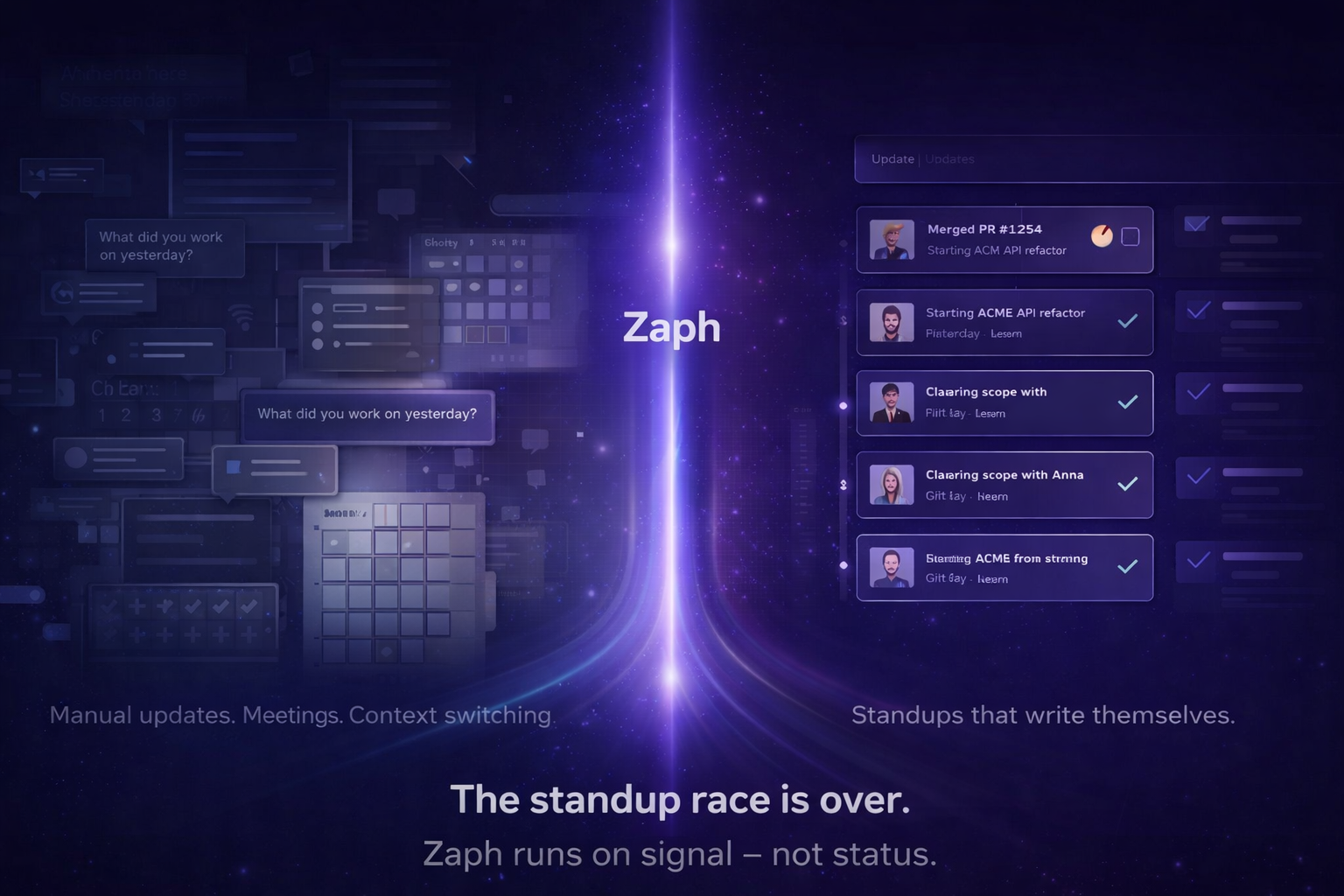
Zaph takes a fundamentally different approach. Instead of asking you what you did, it reads your actual work activity and writes the standup for you.
In this guide, we'll break down exactly how these tools differ — and help you choose the right one for your team.
The Core Difference: Forms vs Intelligence
Before diving into feature comparisons, it's important to understand the philosophical divide:
| Tool | Approach | How Updates Are Created |
|---|---|---|
| Geekbot | Form-based | Bot asks questions, you type answers |
| Standuply | Form-based | Bot asks questions via text/voice/video |
| Steady | Hybrid | Collects tool activity + manual check-ins |
| Zaph | AI-generated | Reads your work, writes your standup automatically |
This distinction matters because it determines how much time you spend on standups and how accurate the updates are.
With form-based tools, you're still doing the work of remembering and writing. With AI-generated standups, you're simply reviewing and approving.
Feature-by-Feature Breakdown
1. Standup Generation
Geekbot
Geekbot operates as a Slack/Teams bot that sends you questions at a scheduled time. You respond with text answers. The bot collects responses and posts them to a channel.
The workflow:
Bot asks → You type answers → Answers posted to channel
Pros: Simple, low learning curve, integrates directly into Slack
Cons: You still manually write every update. Requires daily discipline.
Standuply
Standuply expands on the form-based model with more flexibility. You can respond via text, voice messages, or even video recordings. It supports multiple question templates beyond the standard three.
The workflow:
Bot asks → You respond (text/voice/video) → Responses aggregated
Pros: Voice/video options reduce typing fatigue, highly customizable questions
Cons: Still requires manual input. Voice transcription quality varies.
Steady
Steady takes a hybrid approach. It collects activity from integrated tools (GitHub, Jira, Linear) and combines that with manual "check-in" prompts. The result is a personalized digest that blends automated data with human context.
The workflow:
Activity collected → Check-in prompts → Digest generated
Pros: Reduces manual effort compared to pure form-based tools
Cons: Still relies on you completing check-ins. Digest quality depends on integration depth.
Zaph
Zaph eliminates the form entirely. It connects to your engineering tools — GitHub, Jira, Bitbucket, Confluence, Slack — and reads the actual signals of work: merged PRs, ticket completions, code reviews, discussions.
From these signals, Zaph's AI generates a complete standup draft in natural language. You review it, make any tweaks, and approve. Done.
The workflow:
Activity analyzed → AI writes draft → You review and approve
Pros: Near-zero effort required. Updates reflect actual work, not memory.
Cons: Requires tool integrations (but setup takes minutes).
2. Time Investment Required
This is where the differences become starkly visible:
| Tool | Daily Time Investment | Annual Time Saved vs 15-min Manual |
|---|---|---|
| Geekbot | 5-10 minutes | ~42 hours |
| Standuply | 5-10 minutes | ~42 hours |
| Steady | 3-5 minutes | ~58 hours |
| Zaph | 30 seconds - 1 minute | ~60+ hours |
For a team of 10 engineers, Zaph's approach saves 600+ hours annually compared to manual standups — and 420+ hours compared to other async tools.
That's not marginal. That's weeks of engineering time returned to actual building.
3. Integration Depth
Modern engineering teams use multiple tools. The standup tool needs to understand that context.
| Integration | Geekbot | Standuply | Steady | Zaph |
|---|---|---|---|---|
| Slack | Yes | Yes | Yes | Yes |
| Microsoft Teams | Yes | Yes | No | Planned |
| GitHub | No | Limited | Yes | Yes (deep) |
| Jira | No | Yes (basic) | Yes | Yes (deep) |
| Bitbucket | No | No | No | Yes (deep) |
| Confluence | No | No | No | Yes (deep) |
| Linear | No | No | Yes | Planned |
| Trello | No | Yes | Yes | Planned |
| Asana | No | Yes | No | Planned |
Why integration depth matters:
Geekbot and Standuply are primarily communication tools — they live in Slack/Teams and facilitate message exchange. They don't read your engineering tools.
Steady and Zaph are work intelligence tools — they connect to where work actually happens and extract signal from activity.
The difference? With Geekbot, you might forget to mention that PR you reviewed. With Zaph, it's automatically included because Zaph saw the review happen.
4. Blocker Detection
Identifying blockers early is one of the core purposes of standups. Here's how each tool approaches it:
Geekbot
Relies on you to self-report blockers in response to the "Any blockers?" question. If you forget or downplay, the blocker isn't visible.
Standuply
Same approach — manual self-reporting. Does offer some sentiment analysis on responses.
Steady
Can surface patterns from tool data that might indicate blockers (e.g., a PR stuck in review for days) but doesn't explicitly alert on them.
Zaph
Proactive blocker detection. Zaph analyzes patterns across your standup history and tool activity to identify potential blockers before they're explicitly reported:
- PRs waiting for review for 48+ hours
- Tickets that haven't progressed in days
- Repeated mentions of the same dependency issue
- Workload imbalances across team members
Managers get automatic alerts when potential blockers are detected — no waiting for someone to raise their hand.
5. Team Health & Wellness
Engineering culture increasingly recognizes that sustainable pace matters. How do these tools support team wellness?
Geekbot
Offers basic mood tracking through emoji reactions or custom questions. Provides sentiment analysis dashboards.
Standuply
Similar mood tracking via check-in questions. Can run dedicated "team mood" surveys separately from standups.
Steady
Focuses on "context" and "alignment" — less explicit wellness tracking, more emphasis on reducing coordination overhead.
Zaph
Built-in wellness signals:
- Mood score tracking integrated into daily standups
- Workload assessment based on actual activity volume
- Engagement metrics showing participation patterns
- Alerts when someone's workload spikes or mood trends down
The difference is that Zaph's wellness data is grounded in actual work patterns, not just self-reported feelings. If someone's workload doubled this week, Zaph sees it in the data.
6. Privacy & Control
A common concern with AI tools: who sees what?
Geekbot
Your responses go directly to a shared channel. Everyone sees everything by default (channel-level privacy controls apply).
Standuply
Similar model — responses are shared to configured channels. Some admin controls over visibility.
Steady
Digests are personal by default, with team-level summaries shared separately. More privacy-conscious architecture.
Zaph
Privacy-first design:
- Draft standups are private by default — only you see them until you approve
- You control exactly what gets shared and what stays hidden
- Individual contributors own their narrative, not the system
- Audit trails track who accessed what
This matters because standup tools often expose work-in-progress that engineers aren't ready to discuss. Zaph lets you shape the story before sharing.
7. Scalability
How do these tools perform as teams grow?
| Scenario | Geekbot | Standuply | Steady | Zaph |
|---|---|---|---|---|
| 5-person team | Good | Good | Good | Good |
| 20-person team | Good | Good | Good | Good |
| 50+ person org | Noisy channels | Noisy channels | Complex setup | Multi-team views |
| Multiple projects | Manual channel management | Manual setup | Per-team configuration | Unified dashboard |
Form-based tools tend to create more noise as teams grow — more messages flooding channels.
Zaph's approach scales better because:
- Activity is synthesized, not just collected
- Multi-team dashboards aggregate without overwhelming
- Project-level views let managers see across workstreams
8. Setup Complexity
How hard is it to get started?
Geekbot
5 minutes. Install the Slack app, configure questions, set a schedule. Very simple.
Standuply
10-15 minutes. More configuration options mean more decisions upfront. Integration setup if you want task tracker connections.
Steady
15-30 minutes. Requires connecting multiple integrations to get value. Some learning curve for "Echoes" (AI agents).
Zaph
5-10 minutes. OAuth connections to your tools — no webhook configuration, no API key management. Least-privilege scopes mean minimal security review.
Pricing Comparison
(Note: Pricing as of early 2025. Check official sites for current rates.)
| Tool | Free Tier | Paid Starting Price | Per-User Cost |
|---|---|---|---|
| Geekbot | Up to 10 users | ~$3/user/month | Scales with team size |
| Standuply | 30-day trial | ~$2-4/user/month | Varies by features |
| Steady | Limited free | Not publicly listed | Contact sales |
| Zaph | Free tier available | Competitive | See pricing |
When to Choose Each Tool
Choose Geekbot if:
- You want the simplest possible async standup
- Your team is small (under 10) and cost-sensitive
- You don't need integration with engineering tools
- You're okay with manual daily writing
Choose Standuply if:
- You want voice/video standup options
- You need Agile ceremony automation (retros, planning poker)
- You use Jira/Trello and want basic integration
- You prefer a highly customizable question format
Choose Steady if:
- You want activity digests beyond just standups
- Your team uses Linear, GitHub, and Jira extensively
- You value "context awareness" over pure standup automation
- You don't mind manual check-ins as part of the workflow
Choose Zaph if:
- You want standups that write themselves from actual work
- Your team's time is too valuable for daily form-filling
- You need proactive blocker detection, not just collection
- You want privacy-first architecture (drafts before sharing)
- You're scaling beyond a single team and need unified visibility
The Bottom Line
Most async standup tools solve where and when standups happen — they move them from a meeting room to Slack, from 9 AM to whenever you're free.
Zaph solves whether standups need human writing at all.
The daily standup has always been about one thing: "What's happening with my team?"
With form-based tools, that answer comes from people remembering and typing.
With Zaph, that answer comes from the work itself — commits pushed, tickets closed, reviews completed, discussions had. The AI reads the signal and surfaces the story.
That's not a marginal improvement. It's a different category of tool.
Try It Yourself
The best way to understand the difference is to experience it:
- Sign up for free at zaph.ai
- Connect your tools — GitHub, Jira, Slack (takes 2 minutes)
- See your first AI-generated standup — usually within a day
No forms to fill out. No questions to answer. Just your work, summarized.
Engineering time is precious. Stop spending it on status updates. Let your work speak for itself.
Contributing writer at Zaph. Passionate about engineering productivity and building tools that teams love.