
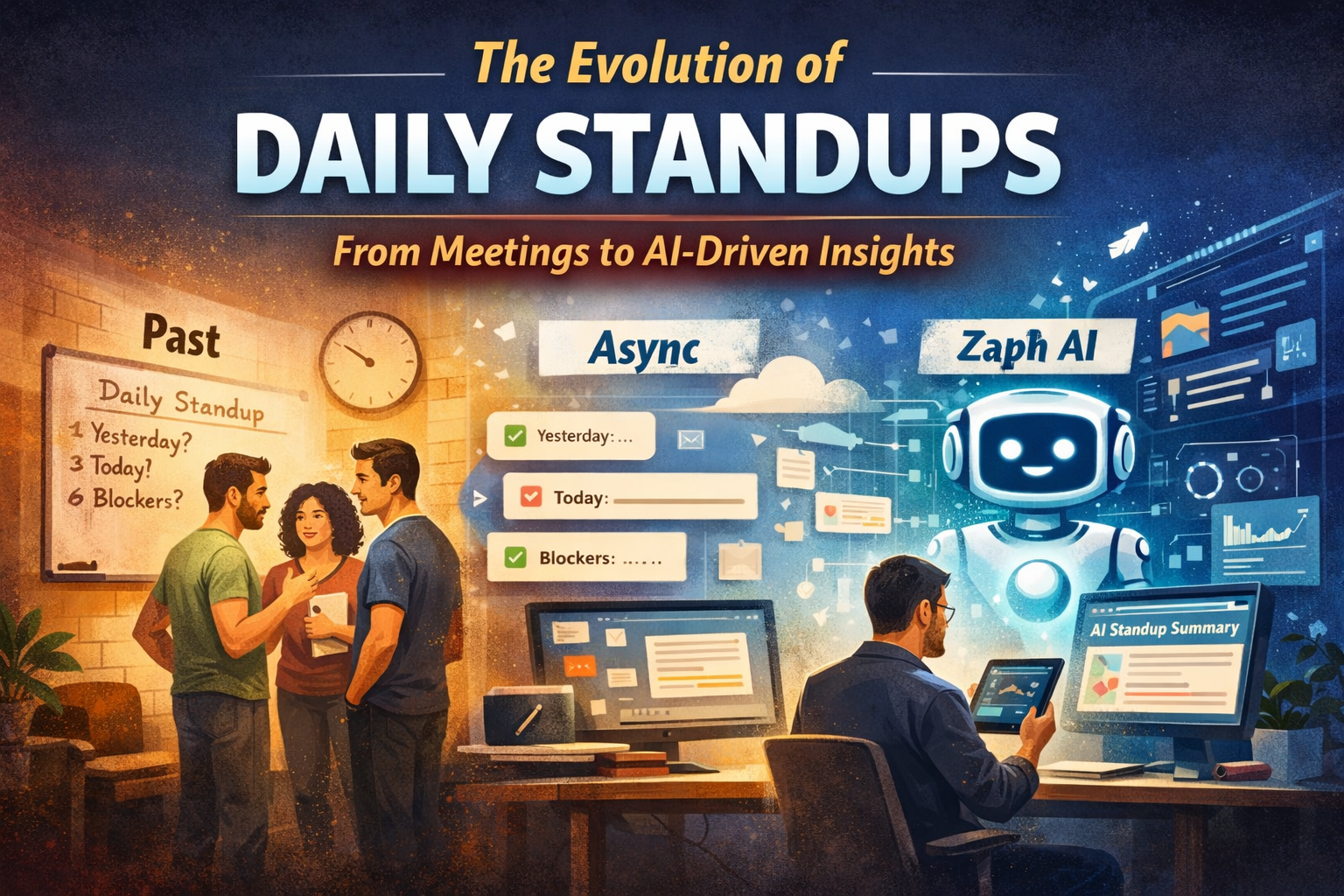
For decades, the daily standup has been the heartbeat of agile software teams. A quick 15-minute huddle where everyone answers three simple questions:
What did you work on yesterday?
What are you working on today?
Any blockers?
Simple. Effective. Until it wasn't.
The Problem with Traditional Standups
In the early days of agile, standups made perfect sense. Teams were small, co-located, and working in the same timezone. A quick morning sync kept everyone aligned without eating into deep work time.
But the world changed.
Teams went remote. Engineers scattered across continents. The "quick 15-minute sync" became a scheduling nightmare spanning London, Bangalore, and San Francisco.
Deep work suffered. For some team members, standups landed right in the middle of their most productive hours. Context switching became the norm.
The ritual became the goal. Teams optimized for having the meeting rather than getting value from it. Status updates became performative rather than informative.
The Shift to Asynchronous Standups
To address these pain points, forward-thinking teams began experimenting with asynchronous standups — written updates submitted on each person's own schedule.
The Benefits Were Immediate
- Timezone flexibility — No more 6 AM calls for distributed teams
- Preserved focus time — Updates happen when convenient, not when disruptive
- Searchable history — Written records create institutional memory
- Thoughtful responses — Time to reflect leads to better quality updates
But New Problems Emerged
Even async standups came with friction:
| Challenge | Impact |
|---|---|
| Manual writing | Engineers spend 10-15 min daily crafting updates |
| Inconsistent quality | Some write novels, others write nothing |
| Information overload | Managers still need to read, digest, and synthesize |
| Still feels like overhead | It's another task on the to-do list |
The async approach fixed the timing problem but not the effort problem. Status updates were still a tax on productivity.
The Next Evolution: AI-Generated Standups
What if standups could write themselves?
That's the premise behind Zaph. Instead of asking engineers to recall and document their work, Zaph reads the actual signals of work happening across your tools:
- Git commits and pull requests
- Jira and Linear ticket updates
- Slack conversations and threads
- Code review activity
Then it synthesizes these signals into a clear, human-readable standup draft that each team member can review, edit, and approve.
How It Works
1. Zaph connects to your existing tools
2. AI analyzes activity signals overnight
3. Each team member receives a draft standup
4. Review, tweak if needed, and approve
5. Team leads get a consolidated view
The result? Standups that reflect what actually happened — not what someone remembers or chooses to report.
Comparing the Three Approaches
| Capability | Sync Standup | Async Manual | AI-Powered |
|---|---|---|---|
| Works across timezones | No | Yes | Yes |
| Preserves deep work | No | Partially | Yes |
| Minimal effort required | No | No | Yes |
| Captures actual work done | Partially | Partially | Yes |
| Creates searchable records | No | Yes | Yes |
| Scales with team size | Poorly | Moderately | Well |
Why This Matters for Engineering Teams
Time is the scarcest resource in software development. Every minute spent on status reporting is a minute not spent building.
For Engineers
- Reclaim 10-15 minutes daily — No more context switching to write updates
- Accurate representation — Your work speaks for itself
- Reduced meeting fatigue — Fewer synchronous touchpoints
For Engineering Managers
- Complete visibility — See what's happening without chasing updates
- Early warning signals — Spot blockers before they escalate
- Team health insights — Understand workload distribution and patterns
For Organizations
- Consistent documentation — Every team follows the same process
- Onboarding acceleration — New hires see the rhythm immediately
- Audit trail — Historical record of team progress
The Future: Context Over Chatter
The evolution of standups mirrors a broader shift in how we think about work communication:
From synchronous to asynchronous.
From manual to automated.
From performative to signal-driven.
Standups were never meant to be theater. They were meant to be a pulse — a daily check that keeps teams aligned without disrupting flow.
AI-generated standups represent the next logical step: communication that emerges from work itself, rather than work that stops for communication.
Getting Started
Ready to see what AI-powered standups look like for your team?
Three steps to get started:
- Connect your tools — GitHub, Jira, Slack, Linear, and more
- Set your preferences — Choose when drafts arrive for each timezone
- Let Zaph do the rest — Review and approve your daily updates
No more blank text boxes. No more trying to remember what you did yesterday. Just clear, accurate status updates that write themselves.
The best standup is one you don't have to think about. It just happens — quietly, accurately, and on your schedule.
Contributing writer at Zaph. Passionate about engineering productivity and building tools that teams love.